







What No One Tells You About Countertop Seams and How to Choose the Least Visible Option
Countertops are the beasts of any kitchen or bathroom, taking daily spills, hot pots, sharp knives, hard hits, and regular cleaning, and being the main area of focus in their room. Remodelling is an expensive venture that involves homeowners taking hours to window shop over samples of materials, colors, edge lines, and finishes, all in an endeavour to achieve that ideal luxurious appearance. However, there is one important factor that is often left out or belittled to near non-existence when the installation team comes to work: seams. These are joints that are formed by bonding two or more pieces of countertop material and can significantly impact the beauty and functionality of your surfaces.
What everyone does not inform you directly, neither the showroom consultant who is eager to provide you with all the information you need, nor the glossy brochures, is that seam is inevitable, and it can be extremely inconsistent in its looks, and it can turn an expensive countertop into a terrible compromise until it is done by a professional. In this exhaustive investigation, we will expose the unspoken truths of countertop seams, explore the interplay of different materials with joints, bust many myths, and elaborate on how professionals can make the best decisions that will give the least visible effect. Regardless of whether you are working on a small but city-based or a large suburban island kitchen, the skill of seams will enable you to steer clear of a few well-known cul-de-sacs, as well as create a scaled, glued final result that will withstand time.
Why Countertop Seams Are Inevitable and Often Downplayed
Fundamentally, a counter-top seam is nothing but the bonded joint of two distinct pieces of material, normally filled by a special adhesive, epoxy, or resin; it is often a color-matched and polished material. But what are the reasons why these joints are there in the first place?
The major cause is due to material constraints. Natural stones like granite, marble, and quartzite are obtained in various quarries in big blocks and sawn into slabs of common sizes of between 9 and 11 feet in length and between 5 and 6.5 feet in width, depending on the source and quality. Different engineered stones are created in analogous or somewhat bigger dimensions, typically up to 120 by 56 inches of standard slab, and occasionally to 130 inches jumbo. When your countertop design has more than such long runs, L-shapes with long legs, large islands that are more than 10 feet, or more than one slab, seams are introduced.
The issue is complicated by logistics. Full slabs weigh an amazing amount; a 3cm granite slab is known to weigh 600 to 900 pounds and is usually difficult to move through standard doorways (usually 36 inches wide), around sharp corners, up the stairs, or via elevators. To reduce the possibility of breakage and provide safe transportation, fabricators often cut slabs into smaller sizes at the off-site or on-site, and add more seams, which could have been prevented with alternative planning. This is further reinforced by weight limits in multi-story buildings or older houses with very narrow access. What nobody will explain to you is that such pragmatic choices are made at the convenience and safety of the installer over the perfection of the aesthetics, which may leave you with a lot more on-the-nose joints than you had expected.
There are also the environmental and structural factors. The change in temperature during transportation is likely responsible for increasing micro-fractures, which provoke precautionary cuts.
The Hidden Impacts: More Than Just Aesthetics
Seams are not a cosmetic issue, but an important functionality and long-term consideration that is hardly emphasized during sales. There should also be a smooth connection between the countertop and backsplash.
Structurally, the weakest points in the countertop are the seams. Cracking or separation may occur due to stress generated by heavy appliances, thermal expansion, or settlement of the house in case the bond fails. This weakness is enhanced in the case of earthquake-prone regions or houses whose foundations shift.
Another issue that is neglected is Hygiene. Even small seams may get minuscule debris, crumbs, or liquids, which form habitats for bacteria or mold, particularly in the area of sinks or prep. This is aggravated by porous materials, provided that they are not sealed properly.
Durability suffers too. The penetration of water through imperfect seals will cause the substrate to swell in particleboard-based (such as laminate) counters, or cause staining in natural stone, or delamination. With time, wear at the edges of seams occurs more easily than in solid parts, with the daily pull of pots, cutting on the surface, etc.
On the one hand, there are conspicuous seams that aesthetically and economically reduce the quality. Any visible line on a top-notch island may turn the entire setup into a sham or unprofessional, which could lower the value of home resale by thousands of pounds. According to industry reports, the kitchen remodel has a good ROI; however, the problems, such as the fact that the seams can be easily noticed, are usually included in the list of complaints or bargaining possibilities as a buyer.
Debunking Persistent Myths About Seams
The countertop sector is full of false notions that may result in unrealized expectations.
- Myth 1 entails the belief that the seams can always be invisibly good.
Although certain installations have been made to be invisible, seamless perfection is not easily possible with slab materials in large patterns. Invisible is usually a term used to describe something that can hardly be perceived with the naked eye.
- Myth 2: Natural stone is not clearly seen to have cracks compared to the engineering ones.
Very frequently, not true – it is hard to match even natural variations, but with engineered quartz consistency blending can be done better.
- Myth 3: There is equal quality in the seam by any installer.
The level of skills is vastly different; amateur work produces large and loose or deep seams.
- Myth 4: None of the seams has an impact on the warranty and the normative.
Lots of warranties do not cover the aesthetic seam problems and bad seams worsen the wear.
- Myth 5: Dark color seems to emphasize the seams more.
It depends upon the pattern; dark with slight movement can conceal more than light solids.
Proven Strategies for Minimizing Seam Visibility
To ensure the presence of discrete seams, proactive measures in planning, selection, and execution are needed.
Optimize Layout and Placement
Digital templating allows for mapping precision slabs. Maximize the size of the islands by single slabs. Eliminate the hide seam in discrete areas: in an L-corner, under an overhang, next to the cooktops, or in an area covered by the faucet. Does not include busy or high-visibility centers.
Breaks Design breaks, alternately at various levels, materials, appliances, etc., are used to provide natural discontinuity (breaks) in surfaces at obviated joints.
Smart Material and Pattern Choices
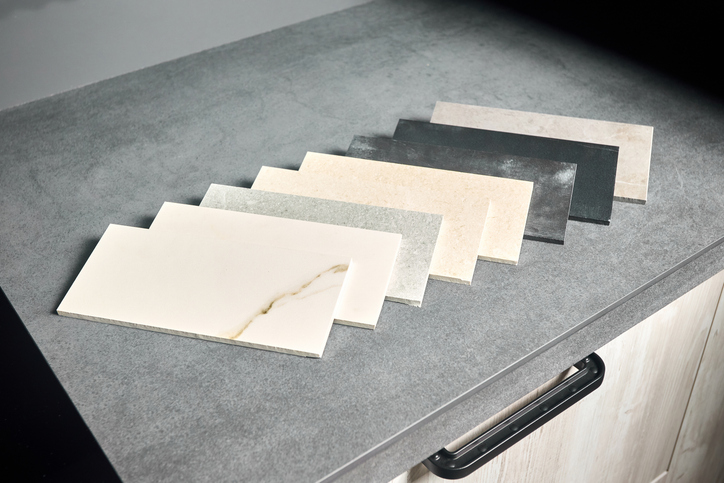
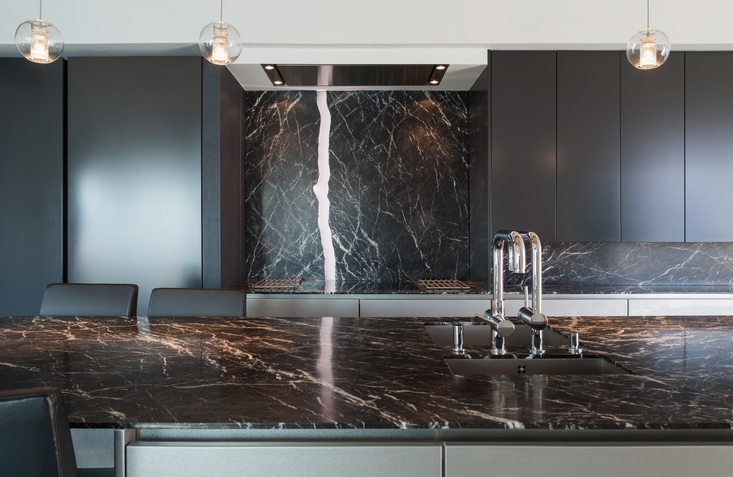
Prefer forgiving fabrics: the medium tones, much speckled, or in tiny veins, as opposed to solids or heavy linear striations. Order sequential slabs of the same dye lot of engineered products or the same block of naturals. It is also important to consider the lighting.
Select Expert Fabricators
Put to the fore certified professionals possessing tight-seam portfolios. Inquire the tools: CNC router: make straight cuts, custom mixers of pigments to epoxies, and use vacuum-clamped flat on the girdle, multi-step polishing.
Demand dry layouts (slabs on position before cutting) and accept positions of seams by means of drawings.
Advanced Techniques and Considerations
In modern practices, there will be micro-beveling of edges to make closer fits, or stone dust is used in the fillers to provide a realistic look, or even polishing can be done in a rolling manner to eliminate halos.
Lighting design is important- do not use spotlights that cast dark lines across; use even, ambient lighting.
Excellence budget: Sewing excellence attracts high costs but avoids unhappy long-term customers.
Final Thoughts
Even though the counter-top seams are inevitable in the majority of the projects, it does not make it the center of attention in designing. The combination of informed selection of materials, careful planning, skilled artisanship, and careful maintenance can make them as near invisible as possible. With your eyes open to all these details, approach your remodel, and you are going to have a beautiful, functional space, which indeed will appear seamless.
Stone Spirit
📞 Call us: (407) 770-0077
💻 www.stonespiritinc.com
Our address: 4108 N Orange Blossom Trl.
Orlando, FL 32804